
Anyone typing “droven io ai automation tools” into Google is usually chasing one of two answers. Either they want to know what Droven.io actually is, or they want to know which automation tools it talks about and whether those tools are worth adopting. This guide answers both, in plain language, without a sales pitch attached to any product.
Droven.io has been showing up more often in searches related to AI, workflow automation, and digital transformation. That visibility has created some confusion, because the name sounds like it could be a software product you sign up for and connect to your CRM. It isn’t. Understanding that distinction early will save you time, and it changes how you should approach the rest of this article.
Table of Contents
What Is Droven.io
Droven.io is a vendor-neutral editorial and knowledge platform focused on artificial intelligence, automation, cloud computing, and related technologies. It publishes structured, research-backed content aimed at helping business owners, operations teams, developers, and curious learners understand the automation landscape before they spend money on it. It does not sell software, run workflows, or connect your apps together.
That single fact resolves most of the confusion around the keyword. People searching “what is droven.io” are often expecting a tool dashboard, a pricing page, or a signup form. What they find instead is closer to an independent research desk content that explains categories of technology (workflow automation, robotic process automation, machine learning, cybersecurity) rather than promoting one company’s product over another. Reading a few articles on the site feels less like a demo and more like sitting down with an analyst who has no stake in which vendor you eventually choose.
The name itself has an interesting backstory that’s worth mentioning, since people often search variations like “about droven.io” hoping to learn the origin. “Droven” is drawn from an older, informal past participle usage of the word “drive.” The idea behind the name is straightforward: a platform driven by curiosity about technology, driven by a purpose to educate rather than sell, and driven by a commitment to accuracy over hype. It’s a small detail, but it explains why the tone across the site reads more like journalism than marketing copy.
Droven io AI Automation Tools Explained
The phrase “droven io ai automation tools” doesn’t refer to a single product. It refers to the broad category of workflow platforms, robotic process automation (RPA) systems, and large language model (LLM) powered agents that the Droven.io platform documents, explains, and compares for its readers. In short: Droven.io is the reference layer, and the tools themselves things like workflow builders, AI agents, and integration platforms are the actual software that businesses deploy.
This distinction matters because most people don’t actually need a longer list of software names thrown at them. What they need is a framework for understanding why two companies can use the exact same tool and get wildly different results. That’s the real value Droven.io style content tries to deliver: not “here are ten tools,” but “here’s how to think about the problem you’re trying to solve before you pick any tool at all.”
At a foundational level, AI automation tools combine three things: a tool-use loop (the ability for an AI system to call external functions or APIs), some form of memory or context retention across a workflow, and for anything customer-facing retrieval-augmented generation, commonly shortened to RAG. RAG grounds an AI’s responses in a business’s actual documents and data rather than letting it rely purely on general training knowledge. Without that grounding, a chatbot or agent will eventually generate a confident, plausible-sounding answer that is simply wrong.
Why Droven io Is Trending Right Now
Search interest around Droven.io has grown alongside the broader surge in AI adoption across small and mid-sized businesses. As more companies move past experimenting with a single chatbot and start looking at full workflow automation, they run into a wall of marketing noise. Nearly every automation vendor claims to be the best, the fastest, or the most “AI-powered” option on the market, and very few of them are willing to say plainly where their own tool falls short.
That gap is exactly where a resource like Droven.io fits in. It positions itself as the counterweight to agency blogs that list the same five tools, call them “the best,” and then quietly offer to implement them for a fee. Review platforms with undisclosed affiliate relationships and content farms recycling the same shallow tool comparisons have made honest, vendor-neutral information harder to find, even though product demos are everywhere. People searching “droven io ai automation tools” are, in many cases, specifically looking for the alternative to that noise.
There’s also a practical trend driving the searches: businesses are past the pilot phase. In 2024 and 2025, plenty of companies ran small AI experiments. By 2026, many are trying to decide what to scale, what to abandon, and what to rebuild properly and that decision requires the kind of grounded, comparative information that editorial platforms like Droven.io are built to provide.
Core Categories Covered Under Droven io AI Automation Tools
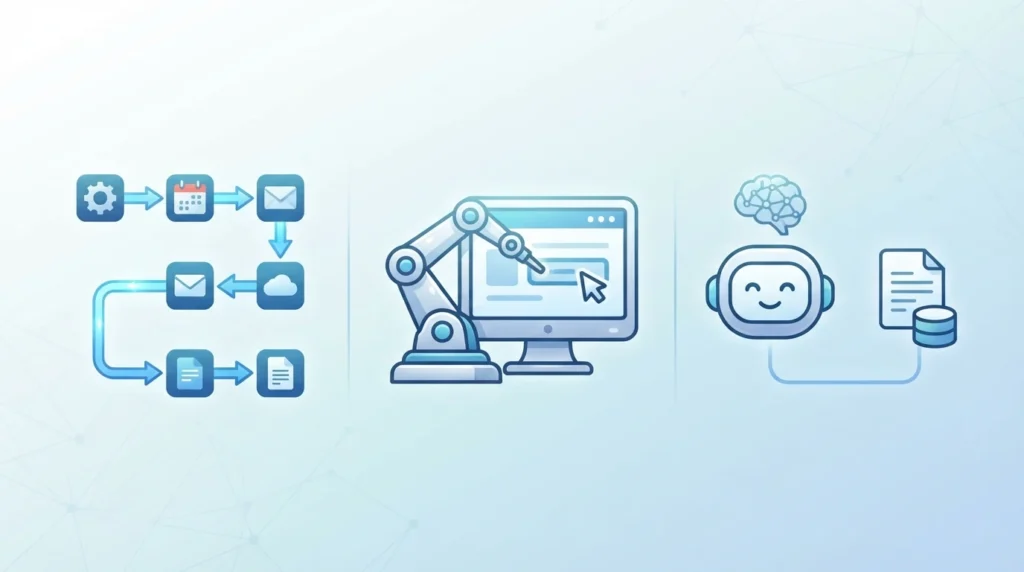
Before comparing individual products, it helps to understand the major categories that fall under the “droven io ai automation tools” umbrella. Picking within the wrong category wastes time and budget regardless of which specific tool you eventually choose, so this framing step is worth taking seriously.
Workflow and integration platforms connect separate applications and trigger automated action sequences based on defined logic or AI detected conditions. Tools like Zapier, Make, and n8n fall here. These are the “if this happens, do that” backbone that coordinates everything else in a stack, and for most small to mid-sized businesses, this is where automation work actually begins.
RPA (robotic process automation) systems focus on mimicking repetitive, rules-based human actions clicking through interfaces, copying data between systems, filling out forms without needing an API integration at all. RPA tends to matter most in industries with legacy software that doesn’t offer modern integration options, such as insurance, healthcare administration, and government services.
LLM-powered agents go a step further than simple triggers. Instead of following a fixed script, these systems use a language model to interpret unstructured input (an email, a support ticket, a voice transcript) and decide what action to take next. This is where most of the recent hype sits, and also where most of the disappointment happens when businesses deploy an agent without the operational discipline to support it.
| Category | Primary Use Case | Typical Skill Needed | Best Fit |
|---|---|---|---|
| Workflow and integration platforms | Connecting apps, triggering actions | Low to moderate | Small businesses, marketing teams |
| RPA systems | Repetitive UI based tasks, legacy software | Moderate | Insurance, healthcare admin, back office finance |
| LLM-powered agents | Understanding unstructured input, dynamic decisions | Moderate to high | Customer support, sales qualification, document processing |
| RAG-based systems | Grounding AI answers in real business data | High | Customer-facing chatbots, internal knowledge bases |
Comparing the Practical Tools Behind the Category
Since Droven.io itself is not software, the actual tools businesses deploy are the practical options readers land on after they understand the category framework above. Three names come up repeatedly in this space, and each serves a genuinely different type of business.
Zapier is the easiest entry point for most teams. It integrates with more than six thousand applications and requires almost no technical background to set up a basic workflow. The tradeoff is cost pricing scales quickly once you’re running a meaningful volume of automated tasks, and complex multi-step workflows can become expensive fast.
Make (formerly Integromat) sits in the middle. It offers more visual flexibility than Zapier for building multi-branch workflows and tends to be more cost-effective at moderate volume, though it has a steeper learning curve for people who’ve never built a flowchart-style automation before.
n8n is the option for teams with in-house technical capability. It’s open-source, self-hostable, and significantly cheaper than the alternatives at high execution volume but it requires a developer to configure, maintain, and troubleshoot. For service-based businesses specifically, an all-in-one platform like GoHighLevel is also worth mentioning, since it bundles CRM, email, SMS, and lead follow-up into a single system, reducing the integration overhead that often stalls smaller automation projects before they even get off the ground.
| Tool | Best For | Learning Curve | Cost at Scale |
|---|---|---|---|
| Zapier | Fast setup, non-technical teams | Low | High |
| Make | Visual multi-step workflows | Moderate | Moderate |
| n8n | Developer-led, high-volume automation | High | Low |
| GoHighLevel | Service businesses, CRM-centric workflows | Low to moderate | Moderate |
Droven io Ai Automation In Usa: Adoption Patterns
Interest in “droven io ai automation in usa” reflects a broader pattern of American small and mid sized businesses moving faster on AI automation adoption than many other regions, largely driven by labor cost pressures and a competitive push to cut operational overhead. Industries like real estate, healthcare scheduling, legal intake, and e-commerce customer service have been among the earliest and most consistent adopters in the US market.
What’s notable in US-based deployments specifically is the emphasis on compliance and data handling. Businesses operating under HIPAA, state level privacy laws, or financial regulations need automation tools that can demonstrate clear audit trails and data residency guarantees. This has pushed many US companies toward self hosted or enterprise-tier automation options rather than the cheapest available tool, since the cost of a compliance failure far outweighs the savings from a lower tier plan.
Regional differences aside, the fundamentals don’t change: a business in Ohio and a business in California face the same core risk when adopting droven io ai automation tools deploying technology faster than their internal processes are ready to support it. Geography affects vendor choice and compliance requirements far more than it affects the underlying strategy for successful automation.
Common Mistakes Businesses Make With AI Automation
Understanding the tools is only half the equation. The other half arguably the more important half is understanding why so many automation projects underdeliver even when the software itself works exactly as advertised.
The single most common mistake is trying to automate everything at once. Teams that succeed generally pick one process, validate it thoroughly, measure the results, and only then expand to a second and third process. Teams that fail tend to roll out automation across five departments simultaneously, discover problems in all five at once, and lose confidence in the entire initiative before any single piece has had a chance to prove itself.
A second recurring failure is skipping the human escalation path entirely. Full autonomy without a clearly defined handoff point to a real person erodes customer trust the moment the system makes a mistake and every system eventually makes a mistake. Developer discussion around agent reliability, particularly in technical communities focused on large language models, consistently circles back to the same conclusion: the failure point is rarely the underlying AI model itself. It’s almost always the surrounding process unclear escalation rules, no fallback plan, and no one monitoring outputs closely enough to catch errors before a customer does.
A third mistake is treating data quality as an afterthought. An automation tool, no matter how sophisticated, can only act on the data it’s given. Feeding a workflow inconsistent, duplicated, or outdated records simply automates the production of bad outcomes faster than a human ever could.
How To Choose The Right Automation Stack
Before selecting any tool under the droven io ai automation tools umbrella, define your use case with real specificity. “Improve customer service” is not a use case. “Automatically triage incoming support emails into three priority tiers and draft a first response for tier-three tickets” is a use case narrow enough to build, test, and measure.
Next, assess your data quality honestly. If your customer records live across four disconnected spreadsheets with inconsistent formatting, no automation tool will fix that problem for you; it will simply automate around the mess, or fail outright. Cleaning and centralizing data before automating is almost always a better use of the first month of any project than jumping straight into building workflows.
Finally, match the technical requirements of the tool to your team’s actual capability, not the capability you wish you had. A self-hosted, developer-maintained platform like n8n is genuinely the cheaper option at scale, but only if someone on your team can actually keep it running. Choosing a tool that requires skills your team doesn’t have is one of the most expensive mistakes in this entire category, because the failure shows up months later, after budget and trust have already been spent.
| Step | What To Do | Why It Matters |
|---|---|---|
| Define the use case | Write a specific, narrow process description | Prevents scope creep and unclear success metrics |
| Audit your data | Check for duplicates, gaps, and inconsistent formatting | Automation amplifies existing data problems |
| Match tool to team skill | Pick based on real in-house capability | Avoids stalled projects and maintenance failures |
| Start with one process | Pilot, measure, then expand | Builds internal confidence and a track record |
Droven io Contact and Getting In Touch
Readers researching “droven io contact” are typically looking to reach out for editorial questions, submit tips, propose a collaboration, or clarify something about a specific article on the platform. Since Droven.io positions itself as an independent knowledge platform rather than a vendor, the most reliable way to find current contact details is directly through the official Droven.io website, where contact forms or listed editorial email addresses are kept up to date. Third-party articles that list specific contact emails or phone numbers for the platform should be treated with caution, since editorial platforms update their contact channels periodically and outdated information tends to linger in older blog posts long after it’s changed.
If your goal in searching “droven io contact” is actually to get help implementing an automation tool rather than reaching the editorial team, it’s worth remembering that Droven.io itself doesn’t offer implementation services. For hands-on deployment help, you’d be looking at the vendor of the specific tool you’ve chosen (Zapier, Make, n8n, GoHighLevel, or similar), or an independent automation consultant. Keeping those two things separate editorial contact versus implementation support avoids a lot of wasted time.
Latest Update on Droven io Coverage
Coverage under the droven io ai automation tools banner continues to expand as the underlying technology moves quickly. Recent editorial focus has leaned into topics like retrieval augmented generation for customer-facing chat systems, the practical differences between agent frameworks, and honest breakdowns of where AI automation projects fail in real deployments rather than in vendor demos.
There’s also been a noticeable shift toward covering security and data-handling considerations alongside the productivity angle. As more businesses move sensitive customer and financial data through automated pipelines, understanding the security posture of a given tool has become just as important as understanding its feature set. Readers researching droven io ai automation tools today are as likely to be comparing audit-log capabilities and data residency options as they are to be comparing pricing tiers.
Reviews and Reader Feedback on Droven.io
Feedback around Droven.io content generally centers on one consistent theme: readers appreciate the absence of a sales pitch. Because the platform doesn’t sell software, run affiliate programs tied to specific vendors, or charge for certifications, its comparisons read differently than the typical “top ten tools” listicle that dominates search results for automation topics. That neutrality is repeatedly cited as the main reason people return to the site before making a purchasing decision.
Some critical feedback exists as well, and it’s worth acknowledging honestly rather than glossing over it. Because Droven.io covers a genuinely broad range of technical topics machine learning, cloud computing, cybersecurity, and automation all at once some readers looking for deep, tool specific technical documentation find the content more conceptual than hands on. That’s a fair characterization of an editorial platform: it’s built to help you understand the landscape and make a confident decision, not to replace a tool’s own technical documentation once you’ve already chosen it.
Frequently Asked Questions
What is droven.io?
Droven.io is a vendor-neutral editorial platform that publishes research-backed content on AI, automation, cloud computing, and related technologies. It is not software, and it does not run automations or connect business applications directly.
Is Droven io a real automation tool I can sign up for?
No. Droven.io itself is a knowledge and editorial resource, not a software product. The actual automation work is carried out by tools like Zapier, Make, n8n, or GoHighLevel, which Droven.io style content compares and explains.
What are droven io ai automation tools exactly?
The phrase refers to the category of workflow platforms, RPA systems, and LLM-powered agents that get documented and compared in this space not one specific piece of software with that name.
How do I contact droven.io?
The most reliable way to find current droven io contact details is through the official website’s contact page, since third-party listings can go out of date.
Which automation tool should a small business start with?
For most small businesses without in-house developers, Zapier or GoHighLevel offer the fastest path to a working automation with minimal technical overhead. Teams with development resources and high automation volume often find n8n more cost-effective long term.
Why is droven io ai automation trending in the USA specifically?
US adoption has been pushed forward by labor cost pressures, competitive pressure to reduce operational overhead, and increasing comfort with AI tools across industries like real estate, healthcare scheduling, and e-commerce customer support.
What’s the biggest mistake businesses make when adopting AI automation?
Trying to automate too many processes simultaneously, rather than piloting one process, validating the results, and expanding gradually. A close second is deploying automation without a clear human escalation path.
Does Droven io recommend or endorse specific vendors?
No. Its positioning is explicitly vendor-neutral, meaning it explains what different tools and categories do without declaring a single “best” option or maintaining paid vendor relationships.
Final Thoughts
The search term “droven io ai automation tools” sits at an interesting intersection of curiosity about a specific platform and a genuine need to understand a fast-moving technology category. Droven.io itself isn’t the software that will automate your business processes it’s the research layer that helps you understand what will, before you commit budget to any single vendor.
The businesses that get the most value out of this space aren’t the ones chasing the newest tool with the flashiest demo. They’re the ones who take the time to define a narrow use case, get their data in order, match a tool to their team’s real technical capability, and expand only after proving out a single process. Whether you land on Zapier, Make, n8n, GoHighLevel, or something else entirely, that discipline matters more than the specific logo on the tool you choose and it’s exactly the kind of grounded, vendor-neutral thinking that platforms like Droven.io exist to provide.
Related Posts
OpenDream AI Art Full Guide.
AI Transformation Is a Problem of Governance.